Building Funa: A Programming Language in Odin - Part 1
I am building a programming language. Here is what has happened so far.
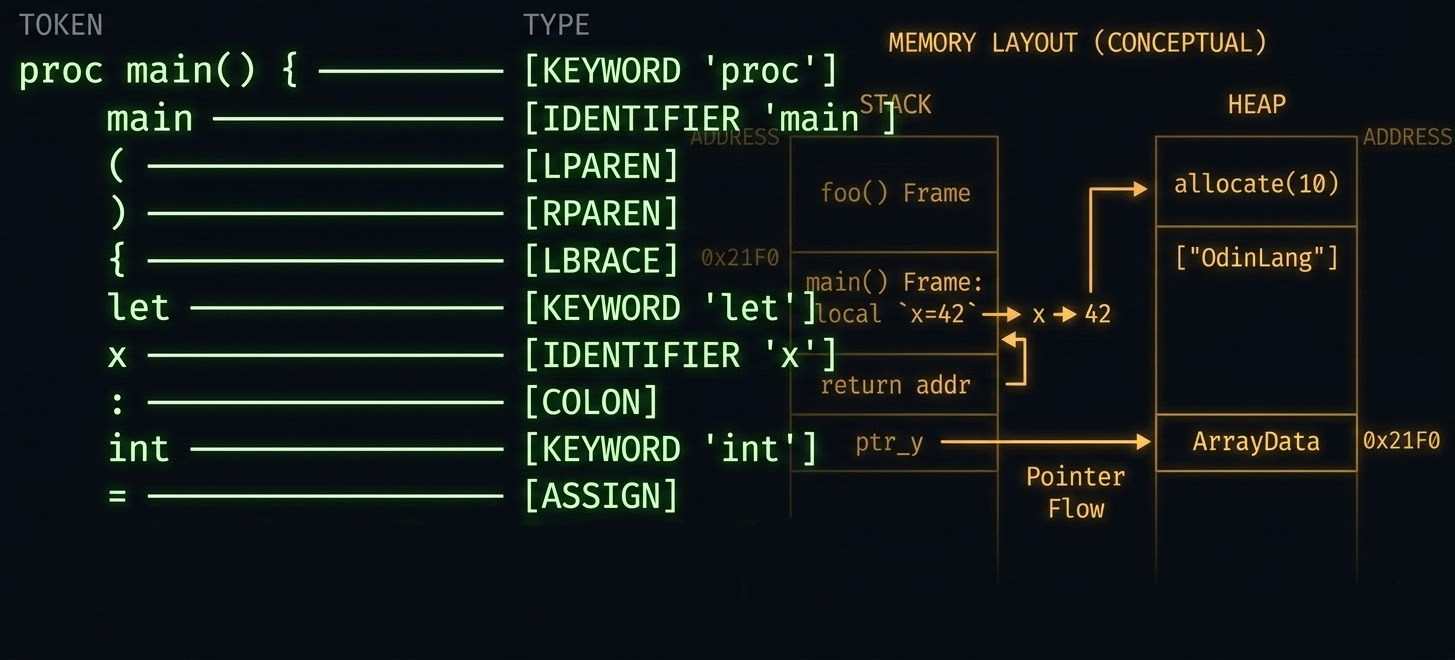
I am building a programming language and I want to document the process. I realised there is little to show for completeness. Right? Many see and they are like: okay? and shrug off not knowing the work that went into it. Am I doing this for others? Yes and no. Yes because, I want people to see that the skills I have or not just on paper, but real. Secondly, someone somewhere might be inspired. No because, even if no one reads my articles, I will still write for myself. It is my way of reflecting and learning.
I’m leaving the old way of showing the finished goods and tell of the process. Though I’m five days late, it is better than later. I’ll be sharing what I’ve been up to in this project: things that worked, things that failed, my lessons and most importantly, the why behind my decision-making.
I called this project funa because it is the short form of the idea: Functional
Automation.
Why Funa?
Funa is a functional programming language for shell automation. The idea is that you write your code and it runs GNU Core Utilities to do the execution.
Here is what Funa looks like right now:
1
2
3
4
5
6
7
8
9
10
let some = 5;
let name = "sam";

function do_something() {
    someone = 34;
}

function findByHoursModified(filename :string, hours :int) {
    someone = 34;
}
We have tokenization working properly. I might remove the semicolons for termination sometime later. I’ll keep them for now. And for the nerds out there, we have something called a language grammar which is presented in Backus Naur Form. I am taking it one at a time and this is the current BNF for the language.
1
2
3
4
5
6
7
8
9
10
11
12
13
14
15
16
17
18
19
20
21
22
* means 0 or many
? means 0 or 1

<program> ::= <statement>*

<statement> ::= <let-bind>
              | <fn-def>

<let-bind> ::= LET IDENT ASSIGNMENT <expr>

<expr> ::= NUMBER | STRING

<fn-def> ::= FUNCTION IDENT LPAREN <param-list>? RPAREN COLON <type> <block>

<param-list> ::= <param> ( COMMA <param> )*
<param> ::= IDENT COLON <type>

<block> ::= LBRACE <statement>* <return-stmt> RBRACE

<return-stmt> ::= RETURN <expr>

<type> ::= "integer" | "string" | "float"
I am building this language in Odin.
Why Odin?
I wanted to learn a language with manual memory management and picked Odin. I chose it because it is a modern systems language. Nothing wrong with C, C++ or Rust. The language does 3 things for me:
- The syntax is close to Go, which is my primary language. Getting up to speed is not an issue.
- Most of the quirks in C, C++ and Rust are addressed in Odin. It doesn’t do a lot, yet gives you the tools to move. I like a simple system it doesn’t tie me to a specific way.
- It’s memory model is an intersection of understanding the technicals of memory and allowing you to do whatever you want without much hustle.
I mean the above points can be considered subjective, but I know a good tool when I see one. Odin is it. That is why I want to learn it. I remember back in 2020 reading about Go and deciding to master the language. It wasn’t as popular as it is today, but I was the potential. Today, it is all over the place.
I’m not saying Odin will take off as Go did. What I’m saying is that it is worth the investment today. Hardware is improving faster than software. It is about time we cared about using the tools for the job, not the tools we know.
I’ll stand on this hill: using javascript for everything is a mistake. Enough talk, back to the context.
Where Things Are
Five days in. The lexer is working. It handles:
- Symbols: parentheses, braces, semicolons, assignment, etc.
- Keywords:
let,function,return, etc. - Data types: integers, floats, strings
- Identifiers
The token type system is a union over three enums:
1
TokenType :: union { Symbol, DataType, Keyword }
Keywords are resolved with a switch-based lookup_identifier to avoid implicit
allocations. String and character literal parsing is handled by a read_string
helper to avoid duplicating that logic.
During development, I use the tracking allocator to catch leaks and Odin’s
built-in test runner to validate new features. For the harder bugs,
GDB with debug symbols (odin build . -debug).
What Happened Today
I ran into memory issues and I want to walk you through each one.
The Setup
The lexer reads a file line by line and tokenises each line. All the tokens need to be collected into one array for the parser. Here is what it looks like:
1
2
3
4
5
6
7
8
9
10
11
12
run_lexer :: proc(s: string) -> [dynamic]token.Token {
    l := lexer.new(s)
    tokens := make([dynamic]token.Token)

    for tok := lexer.get_next_token(&l);
        tok.type != token.Symbol.EOF;
        tok = lexer.get_next_token(&l) {
        append(&tokens, tok)
    }

    return tokens
}
Garbage Values
The first thing I saw was something like this:
1
2
Token{literal = "\x1dN\x87\xa5", type = "STRING"}
Token{literal = "\x0e\n\x1d",    type = "INTEGER"}
I learnt that in Odin, string is just a {ptr, len} pair. It does not own the
memory it points to. The lexer was storing slices directly into the input line.
When that line went away, the token literals were pointing at garbage. I’m accessing
data in a memory location in which the data has been freed. Not good.
Attempted Fix: strings.clone
One thing I know about memory is the concept of heap and stack. The idea of cloning
came from using rust
a few years back. I decided to clone the memory so that
the lifetime extends beyonds the scope by creating a new allocation for it in a
larger scope.
This is how I went about it in Odin:
1
2
tok.literal = strings.clone(tok.literal)
append(&tokens, tok)
That fixed the garbage values. But now every token literal was a heap allocation I had to free manually:
1
2
3
4
defer {
    for tok in tokens do delete(tok.literal)
    delete(tokens)
}
Not great for a programming language where parsing source code is one of the core features.
The Fix: Context Allocator and Dynamic Arena
I went to revise the notes I made earlier on types of memory management in Odin. Let me give you a brief about them:
- heap_allocator: general purpose, default.
- arena_allocator: many short-lived allocs, free all at once.
- temp_allocator: scratch allocator meant to be reset periodically.
- tracking_allocator: debugging; detects leaks and double-frees.
The way to use these allocators is to update the context allocator. Like the name, it is the allocator being used in the current context/scope.
I decided to use an arena allocator in the context where I call the function. Any memory created in the scope of the context allocator will be inside the ‘arena’. To clean things up, I free only the allocator.
Translating that into code:
1
2
3
4
5
6
7
8
9
10
11
12
13
14
arena: mem.Dynamic_Arena
mem.dynamic_arena_init(&arena)
defer mem.dynamic_arena_destroy(&arena)
context.allocator = mem.dynamic_arena_allocator(&arena)

tokens := make([dynamic]token.Token)

for {
    line, read_err := bufio.reader_read_string(&reader, '\n')
    // arena-owned, no cleanup needed

    line_tokens := run_lexer(line)
    append(&tokens, ..line_tokens[:])
}
I do not need to change the implementation of the lexer. No strings.clone is
needed in the run_lexer procedure because the line strings are already in the
arena and stay valid for as long as the arena is alive:
1
2
3
4
5
6
7
8
9
10
11
12
run_lexer :: proc(s: string) -> [dynamic]token.Token {
    l := lexer.new(s)
    tokens := make([dynamic]token.Token)

    for tok := lexer.get_next_token(&l);
        tok.type != token.Symbol.EOF;
        tok = lexer.get_next_token(&l) {
        append(&tokens, tok)
    }

    return tokens
}
Why This Works (Technical Correctness)
The arena holds one contiguous block of memory. Every allocation bumps a pointer forward:
1
2
[ arena backing buffer                              ]
  ^tokens  ^line1  ^literal1  ^literal2  ^line2  ...
When mem.dynamic_arena_destroy is called via defer, the whole block is freed
at once. No looping over tokens. No per-literal delete. Everything has the same
lifetime, the arena owns it all.
Read more on memory allocation strategies from Ginger Bill’s series
Output
The lexer now correctly tokenises a Funa source file:
from:
1
2
3
4
5
6
7
8
"Hello World"
'some'
233
23.3
let some = 5;
function app() {
	someone = 34;
}
to:
1
2
3
4
5
6
7
8
9
10
11
12
13
14
15
16
17
18
Token{literal = "Hello World", type = "STRING"}
Token{literal = "233",         type = "INTEGER"}
Token{literal = "23.3",        type = "FLOAT"}
Token{literal = "let",         type = "LET"}
Token{literal = "some",        type = "IDENTIFIER"}
Token{literal = "=",           type = "ASSIGNMENT"}
Token{literal = "5",           type = "INTEGER"}
Token{literal = ";",           type = "SEMI_COLON"}
Token{literal = "function",    type = "FUNCTION"}
Token{literal = "app",         type = "IDENTIFIER"}
Token{literal = "(",           type = "LPAREN"}
Token{literal = ")",           type = "RPAREN"}
Token{literal = "{",           type = "LCURLY"}
Token{literal = "someone",     type = "IDENTIFIER"}
Token{literal = "=",           type = "ASSIGNMENT"}
Token{literal = "34",          type = "INTEGER"}
Token{literal = ";",           type = "SEMI_COLON"}
Token{literal = "}",           type = "RCURLY"}
What I Learned
- Strings in Odin are just pointers. They don’t own their memory. If what they point to goes away, you get garbage.
- Arenas are the right tool when allocations share a lifetime. Simpler and harder to get wrong than per-item cleanup.
- Odin’s context allocator makes this composable. Swap the allocator once, everything downstream follows. No changes needed in the functions that allocate.
What’s Next
Lexer is done. Next is the parser to build an Abstract Syntax Tree from the token stream. I have already settled on using the recursive descent strategy. Along the way, I’ll be expanding Funa’s expression syntax.
Yeah, that’s all for now. Take care.